
Implementing and Integrating Foundation Models in AI Applications


Building AI applications with foundation models is about working smarter, not harder.
It’s about moving beyond simple API calls and making practical engineering decisions that save you time and headaches later. You need smart architectural choices for your data, intelligent ways to manage your models, and cost-aware strategies like Retrieval-Augmented Generation (RAG) or fine-tuning. And, of course, prioritizing robust observability and keeping your options open with different models. This approach is key to managing performance and keeping costs from spiraling out of control in production.
What Are Foundation Models?
Think of foundation models (FMs) as incredibly powerful deep learning neural networks. They’re trained on vast, general, and unlabeled datasets, which means they can do a huge variety of general tasks – like understanding language, generating text and images, or having a natural conversation. Unlike traditional machine learning models, which usually do one specific thing really well, FMs are adaptable. They can handle many different tasks with high accuracy, just by giving them the right input prompts. This adaptability allows FMs to perform a wide variety of general tasks, including understanding language, generating text and images, and conversing in natural language.
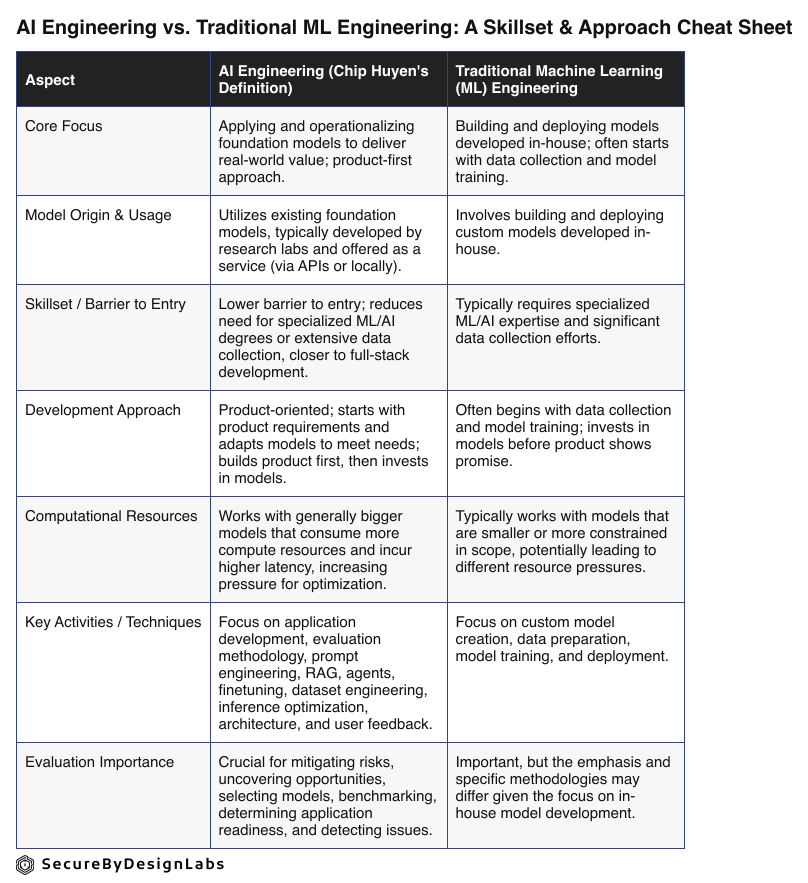
You can easily get pre-trained foundation models through APIs from major providers like OpenAI, Anthropic, Google Gemini, and Amazon Bedrock. This accessibility has lowered the technical barrier for ML integration for your team. It also means that where you differentiate yourself competitively has shifted. This means your competitive advantage now comes from skills in prompt engineering, building RAG pipelines, and fine-tuning models with proprietary data, rather than from extensive model training from scratch.
Your Step-by-Step Guide to Foundation Model Integration
Bringing foundation models into your AI applications requires an approach that prioritizes prompt engineering, RAG pipelines, and fine-tuning on proprietary datasets. It’s about making sure it’s robust, scalable, and maintainable by focusing on competitive differentiation through prompt engineering, RAG pipelines, and fine-tuning on proprietary datasets. Our process guides you from understanding the basics to deploying and continually improving your systems in production.
This flowchart helps you visualize the key steps and decisions involved in integrating foundation models. It highlights the strategic thinking required, from getting started with a model to ongoing deployment and monitoring.

Your Step-by-Step Foundation Model Integration Playbook
Architectural Choices: Picking Your Integration Pattern
When you’re integrating foundation models, choosing the right architectural pattern is a critical decision. It directly affects your application’s performance, cost, and how much you can customize the model’s behavior. The main approaches you’ll consider are Retrieval-Augmented Generation (RAG), fine-tuning, and using on-device or edge FMs.
- Retrieval-Augmented Generation (RAG): This AI framework helps Large Language Models (LLMs) by letting them pull in relevant information from an external knowledge base, like a vector database. RAG helps models generate more accurate, grounded responses, which reduces instances of incorrect or misleading output that could otherwise undermine trust and lead to costly errors for your company.
- Foundation Model Fine-tuning: Platforms like Databricks offer fine-tuning capabilities. This lets you customize foundation models using your own proprietary data. It saves significant time and compute resources for your company, allowing teams to develop and deploy customized models more rapidly and cost-effectively. For example, Databricks makes sure your fine-tuned model checkpoints are saved to MLflow and automatically registered in Unity Catalog.
- On-Device/Edge FMs: For certain situations, using foundation models directly on devices or at the edge offers advantages like cost-free, privacy-preserving, offline AI functionality. Apple’s Foundation Models Framework (which you’ll find on iOS 26+, iPadOS 26+, macOS 26+, and visionOS 26+ devices with Apple Silicon) gives you AI functionality that’s free, privacy-preserving, and works offline. This framework delivers impressive performance, with 0.6 milliseconds time-to-first-token latency on an iPhone 15 Pro and 30 tokens per second generation, enabling highly responsive and seamless AI experiences for users directly on their devices. Apple Intelligence uses small collections of model weights, called adapters, that can be dynamically loaded and swapped, allowing the base foundation model to specialize for everyday tasks without needing to load an entirely new model, which optimizes resource usage and task-specific performance.
Keeping Costs Down and Performance Up
Managing costs and making sure your foundation models perform consistently, with predictable token consumption and latency, are essential, especially when they’re in production. If you don’t plan carefully, inference costs from API access can quickly spiral out of control and blow your budget without leveraging strategies like priority pay-per-token or provisioned throughput.
Databricks, for instance, gives you flexible ways to access their Foundation Model APIs. While a pay-per-token approach is great for just starting out and experimenting, for production workloads that need consistent performance and guaranteed resources, they recommend priority pay-per-token or provisioned throughput to ensure your applications remain reliable and cost-efficient at scale.
Ensuring Observability and Managing Risk
Having robust observability is absolutely essential for keeping your AI applications high-quality, safe, and reliable, by measuring quality, safety, reliability, and monitoring metrics like token consumption, latency, and error rates. It lets you catch issues early, debug effectively, and make sure you’re meeting regulatory standards.
Microsoft Foundry, for example, offers comprehensive observability tools. These include evaluations to measure quality, safety, and reliability, along with real-time monitoring dashboards that track key metrics like token consumption, latency, and error rates, providing immediate insights to maintain system health and mitigate operational risks. They also have tracing tools built in to help with debugging.
Beyond that, frameworks like NIST AI 100-1, the ‘Artificial Intelligence Risk Management Framework,’ provide foundational federal guidance for classifying AI systems, which helps your company manage risks and ensure ethical deployment. Paying attention to frameworks like NIST AI 100-1 is crucial for managing risks and deploying AI responsibly by providing foundational federal guidance for classifying AI systems.
From Prototype to Production: The Loop of Improvement
Deploying AI applications with foundation models, which are often embedded into search engines, image generation, and internal knowledge search, isn’t a one-and-done deal. It’s an ongoing, iterative process of deployment, monitoring, and continuous improvement. Real-world applications like the NFL Players Association reducing video review time by 73% (per microsoft.com) are already showing the tangible benefits of well-implemented foundation models.
We see organizations like Google and Microsoft embedding foundation models directly into search engines. Photoshop now integrates image generation models, and firms like Morgan Stanley use LLMs for internal knowledge search and retrieval. These examples clearly show how versatile FMs are across different industries, highlighting opportunities for your company to integrate AI into diverse applications, from search to internal knowledge management.
Many organizations are already seeing significant returns:
- Over 85% (per microsoft.com) of Fortune 500 companies use Microsoft AI solutions, and 66% (per microsoft.com) of CEOs report measurable business benefits from generative AI, which means your company can expect to see improved workflows, reduced costs, and enhanced customer experiences. (Microsoft)
- The NFL Players Association cut video review time by up to 73% (per microsoft.com) by integrating Azure AI services, which allows for better player safety through consistent rule enforcement, reducing the risk of injuries and legal liabilities for the organization. (Microsoft)
- McKnight Foundation rolled out Microsoft 365 Copilot to all staff, which led to significant time savings and increased productivity, allowing employees to focus on higher-value strategic initiatives that drive company growth. (Microsoft)
- UST Global developed an AI solution powered by Azure OpenAI Services-based foundation models to process and interpret complex patient information. (Microsoft)
- ACI Infotech helped a Fortune 500 healthcare client achieve an 87% (per aciinfotech.com) reduction in manual eligibility verification time using Robotic Process Automation (RPA), which significantly reduces operational costs and speeds up patient onboarding. (ACI Infotech)
The Foundation Model Ecosystem: A Quick Look
Navigating the world of foundation models, orchestration frameworks, and integration patterns can feel complex. It helps to understand the trade-offs involved. This comparison gives you a quick reference for key attributes and what they mean for your AI application.
This table lays out the characteristics, benefits, and examples for various foundation models, integration patterns, and cost management strategies. It’s designed to help you make informed decisions based on your project’s specific needs, considering aspects like performance guarantees and token consumption.
Foundation Model Ecosystem: Quick Reference Guide
The Principal Engineer’s Lens: Beyond the API Call
For principal engineers, bringing foundation models into the fold means much more than just picking an API or a framework; it involves anticipating second-order effects from choices like pay-per-token vs. provisioned throughput. It’s about anticipating second-order effects and designing systems for long-term maintainability and cost-effectiveness, especially considering the shift in competitive differentiation to prompt engineering, RAG pipelines, and fine-tuning. The strategic foresight required here means you’re not just thinking about immediate performance, but also about scalability, security, and the operational costs throughout the entire lifecycle of your AI system.
Strategic decisions always involve trade-offs. For example, using powerful, pre-trained models via APIs can be easier to integrate and manage infrastructure for, but it might lead to higher inference costs and less control. On the flip side, fine-tuning open-source models gives you more control over model behavior and potentially lower long-term costs for your company, but it demands greater expertise from your team and a larger initial investment in infrastructure. Similarly, choosing between LangChain’s broad integrations and LangGraph’s precise multi-agent control means weighing how much flexibility you need versus how much granular control you want for complex workflows.
Your considerations should definitely extend to managing operational costs. Building foundation models from scratch is incredibly expensive. Relying on third-party FMs through APIs can quickly lead to exploding budgets if you don’t carefully manage inference costs. That’s why efficient RAG strategies – including smart chunking, embedding, and retrieval – are crucial for reducing token consumption. Observability tools are vital for tracking these metrics and keeping your budget in check.
Security Implications 
Security is paramount here. This means thoroughly reviewing AI-generated code for vulnerabilities like hardcoded secrets or missing input validation, making sure your API integrations are secure, and governing which models can access sensitive data. In enterprise settings, having policy-aware context delivery and tracking model access to sensitive data are critical for compliance. Designing AI responsibly, with a focus on trust and reliance, is an integral part of secure development.
Common Mistakes to Avoid in AI Application Development
Developing AI applications with foundation models comes with its own unique set of challenges and potential pitfalls. Avoiding these common mistakes, particularly neglecting specialized observability for model performance and reasoning chains, can save you significant time and resources, leading to more robust and successful deployments.
- Model Drift: This is the silent degradation of performance over time, often due to shifts in input data or real-world conditions. It’s why continuous monitoring and re-evaluation are essential.
- Data Quality Issues: You’ve heard it before: “garbage in, garbage out.” Brittle data scrapers, unstructured data, and stale datasets can seriously weaken your RAG retrieval layer, leading to poor model performance.
- Over-reliance on Prompt Engineering: Just relying on prompt engineering without a solid architectural foundation can lead to brittle systems that are tough to scale and maintain.
- Underestimating Inference Costs: Inference costs can quickly lead to budget overruns if you don’t manage them carefully through efficient model selection and hybrid approaches.
- Neglecting Security and Compliance: Especially in sensitive domains, ignoring security and compliance can lead to data breaches and serious regulatory penalties.
- Insufficient Monitoring: Don’t assume traditional application monitoring is enough for AI systems. AI systems need specialized observability to track model performance, data quality, and reasoning chains. Neglecting AI system design principles can lead to bottlenecks, outages, or costly rewrites. As a stark reminder, in 2024, the global average cost of a data breach reached USD 4.88 million – underscoring just how important robust AI observability really is.
Next Steps
Begin by evaluating your current AI application strategy against the ‘Implementing and Integrating Foundation Models in AI Applications’ flowchart. Identify your primary integration pattern, whether RAG, fine-tuning, or on-device FMs, and assess your current cost and observability practices based on the insights provided.




Responses