
What is AI Engineering, as Defined by Chip Huyen, and Why Does it Matter?

AI Engineering, as defined by Chip Huyen, offers a method for building AI systems that starts with defining product requirements and adapting models to meet those needs.
This discipline focuses on getting existing foundation models to solve specific product problems and contribute to business goals, moving from creating bespoke models to integrating and rigorously testing existing models within applications.
This guide breaks down Huyen’s definition of AI Engineering, how it differs from traditional ML engineering, essential techniques like prompt engineering and RAG, and critical considerations for successful deployment. Understanding this framework helps you understand current best practices and future trends in AI application development, shorten the cycle from idea to deployment by leveraging existing foundation models, and create AI products that meet user needs and perform reliably with fewer resources.
Understanding AI Engineering: A Product-First Approach
Chip Huyen defines AI Engineering as a discipline focused on applying and operationalizing foundation models to deliver real-world value. This involves building applications that leverage existing foundation models, which are typically developed by research labs and offered as a service. It represents a significant shift towards more engineering and product-focused work, moving away from the custom model creation that characterized traditional machine learning applications.
The core of Huyen’s definition is a product-oriented workflow. This means you start with product requirements and adapt models to meet those specific needs, rather than beginning with data collection and model training. The following diagram illustrates this product-first process in AI Engineering:

This workflow highlights a continuous cycle of building, evaluating, and refining AI applications. Key steps include selecting appropriate foundation models, rigorously evaluating application performance, addressing production challenges like hallucinations and latency, and developing user-friendly interfaces.
AI Engineering vs. Traditional ML Engineering: A Clear Distinction
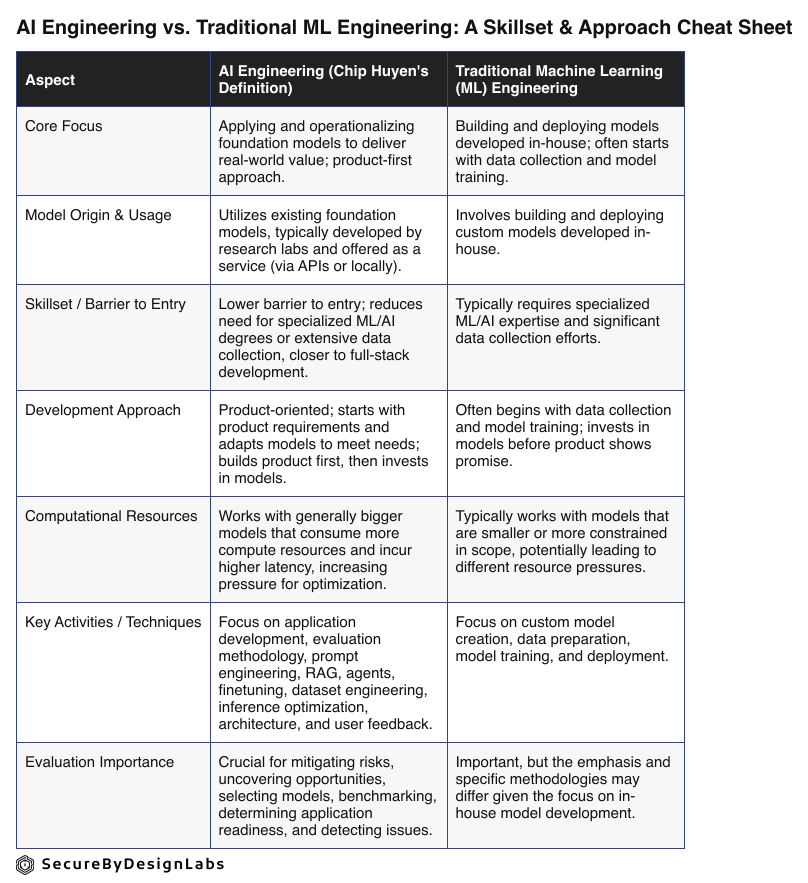
Chip Huyen explicitly distinguishes AI engineering from traditional machine learning (ML) engineering. While ML engineering typically involves building and deploying models developed in-house, AI engineering prioritizes the application and operationalization of existing foundation models. This difference impacts everything from the required skillset to the development approach and computational resources.
The comparison below highlights the fundamental differences between these two disciplines:
This distinction is vital for understanding the unique challenges and opportunities in AI Engineering. It clarifies that while both fields are critical, they address different stages and aspects of AI system development. The evidence points to most practical AI systems often combining both approaches, using foundation models for core generative tasks and locally built components for specialized functions like request classification.
Key Concepts and Techniques in AI Engineering
Once you grasp the overarching workflow, it’s crucial to understand the core concepts and actionable techniques central to Chip Huyen’s AI Engineering framework. This approach is designed to be practical, emphasizing methods that help engineers effectively leverage foundation models for real-world applications.
This checklist outlines the essential elements and foundational techniques that define the discipline, from understanding model application to addressing production challenges. It highlights how you can master these areas to create AI applications that reliably meet their intended goals and user needs.

AI Engineering Techniques: Your Core Skills Checklist
Why AI Engineering Matters: Impact and Accessibility
AI Engineering, as envisioned by Chip Huyen, significantly lowers the barrier to entry for building AI applications. By leveraging readily available foundation models via APIs or local deployments, it reduces the need for specialized ML/AI degrees or extensive data collection. This makes AI development more accessible to a broader range of engineers.
✚ It lowers the barrier to entry for building AI applications, potentially reducing the need for specialized ML/AI degrees or large amounts of proprietary data collection.
✚ It enables a product-first approach which can lead to faster time-to-market for AI-powered features compared to traditional ML development.
✚ It places increased emphasis on application development and user interfaces, bringing it closer to full-stack development and making it accessible to front-end and full-stack engineers by bridging their existing skills with AI development.
This shift empowers more software engineers to transition into AI, and allows ML engineers to make AI applications easier to integrate into products and more stable in production. This knowledge is particularly relevant during the early stages of an AI project, influencing product ideation and architecture design, and continues to be crucial throughout the development lifecycle for evaluation, deployment, and optimization.
Practicality and Outcomes: Building Robust AI Systems
AI Engineering is inherently practical, focusing on actionable techniques and solving issues like hallucinations, security vulnerabilities, and high operational costs in deployed AI systems. Its ultimate goal is to create AI systems that are reliable, perform well under load, and directly address business or user needs.
This discipline emphasizes:
- Understanding LLMs: Grasping the capabilities and limitations of large language models.
- Evaluation Methodology: Crucial for identifying and reducing potential problems, choosing the right models, tracking performance improvements, and ensuring an application is ready for deployment.
- Prompt Engineering: Crafting effective inputs to guide foundation models toward desired outputs.
- Retrieval-Augmented Generation (RAG): Enhancing model responses by retrieving information from external knowledge bases.
- Finetuning: Adapting pre-trained models to specific tasks or datasets.
- Inference Optimization: Addressing the increased compute resources and latency associated with larger models to ensure efficient performance at scale.
By focusing on these techniques and a product-oriented approach, AI Engineering helps mitigate common issues like hallucinations, security vulnerabilities, and high operational costs.
Principal Engineer Lens: Trade-offs and Strategic Decisions
For principal engineers, AI Engineering presents a distinct set of strategic considerations and trade-offs beyond just the mechanics. The choice to leverage existing foundation models via APIs often means exchanging deep customization of models for quicker development and simpler management of deployed systems.
✕ Misapplying foundation models to problems where custom ML models are more appropriate.
✕ Inadequate evaluation methodologies leading to unreliable AI systems.
✕ Poor prompt engineering resulting in undesirable model behavior.
✕ Neglecting inference optimization, which can lead to high operational costs and slow user experiences.
✕ Over-reliance on black-box models without understanding their limitations or biases.
Strategic decisions involve making decisions that ensure chosen models effectively meet product requirements, understanding the increased compute resources and latency of larger models, and recognizing the essential for identifying and reducing potential system failures and informing high-level choices about AI initiatives. The simplest solution often involves leveraging existing, well-tested foundation models through APIs, focusing on effective prompt engineering and RAG, rather than immediately resorting to fine-tuning or training custom models. This product-first approach builds quick, basic AI applications, then iteratively improves them according to product specifications.
Security Considerations in AI Engineering 
AI systems, particularly those built with external foundation models, introduce unique security implications that you need to address proactively. While not always explicitly detailed, the need for thorough testing, careful deployment practices, and adherence to ethical guidelines contribute to the security of AI systems.
AI Engineering emphasizes addressing production issues, including security, in building robust AI systems. Secure development lifecycle (SSDLC) practices are crucial for the application development layer. This includes securing APIs, managing access to sensitive data, and ensuring model outputs do not inadvertently reveal confidential information or generate harmful content. New attack vectors like prompt injection and data poisoning during fine-tuning require careful consideration.
Scalability and Operational Costs
Chip Huyen’s work provides a practical guide for building robust and scalable AI systems, emphasizing application development and addressing production issues. AI Engineering designing systems to perform efficiently and reliably as user demand and data volume increase, through optimized model execution, smart system structure, and dependable deployment methods for applications built on foundation models.
Operational costs are a significant consideration, especially with large foundation models that can incur substantial inference costs through API calls. This discipline addresses cost by discussing inference optimization techniques, architectural choices, and evaluation methods that improve efficiency and reduce expenses, such as knowing when fine-tuning is (or isn’t) necessary. Effective evaluation can also prevent the costly deployment of underperforming systems.
Next Steps
Begin implementing a product-first approach in your AI projects by leveraging existing foundation models and focusing on iterative prompt engineering and Retrieval-Augmented Generation (RAG) techniques before considering more complex finetuning. Continuously evaluate your application’s performance against product requirements to ensure real-world value delivery.


Responses