
Understanding Foundation Models for AI Application Development


Understanding Foundation Models for AI Application Development
Foundation models (FMs) really change how we build AI applications. They let you develop things faster and more affordably by tapping into their huge, pre-trained knowledge base. But for them to actually reliably automate tasks or generate useful content in live systems, you need a structured process for managing model versions, performance, and updates. That means constant versioning, thorough evaluation, sticking to Responsible AI principles, and planning ahead for when models need to be retired.
Without this, models can gradually lose accuracy or effectiveness without immediate alerts, leading to risky upgrades, unexpected behavior, or outages.
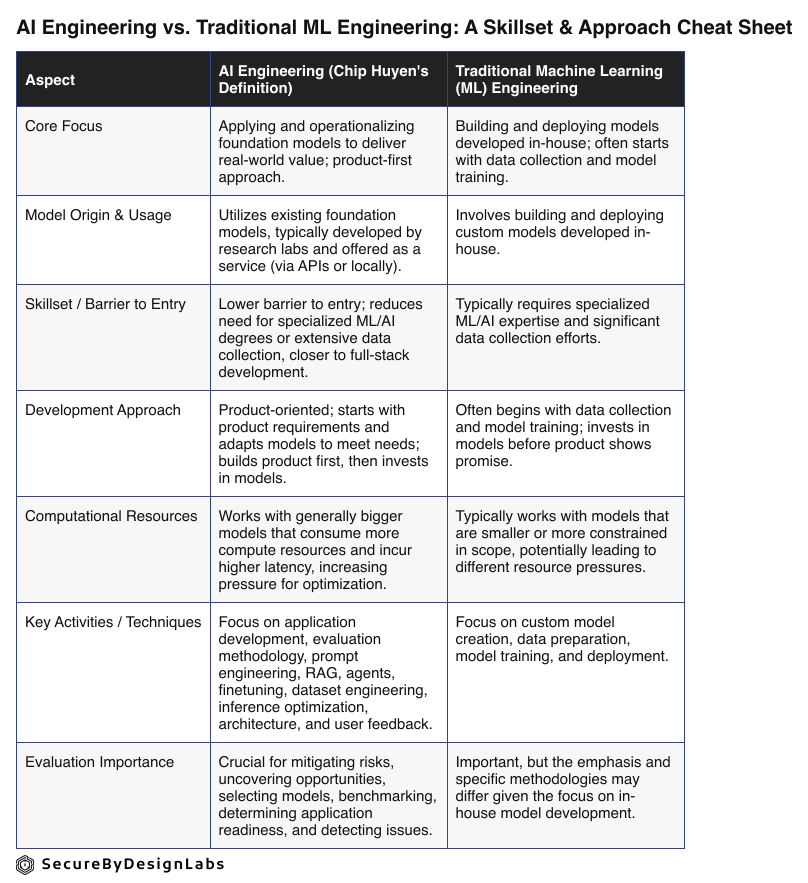
FMs are large deep learning neural networks, built by training them on massive, varied, and unlabeled datasets. What sets them apart from traditional machine learning models—which are usually built for one specific, narrow job—is their general-purpose nature. They can handle a wide array of different tasks, like natural language processing (NLP), answering questions, or classifying images, all based on the prompts you give them. A key point: foundation models also have emergent capabilities. This means they can perform tasks they weren’t explicitly trained to do, a trait that often shows up as models grow in size and complexity.
Navigating the Foundation Model Lifecycle
Putting foundation models into production successfully means taking a an ongoing process of development, evaluation, deployment, and monitoring. Think of it as a loop: development, evaluation, deployment, monitoring, retraining, and retirement. This isn’t a one-time checklist; it’s a flexible operations that ensure sustained accuracy, low latency, and consistent output. Building AI applications with foundation models means you’ll need to integrate them into a software stack that includes specialized tools for things like prompt engineering, fine-tuning, and pipeline engineering.
Here’s a look at that continuous journey of managing foundation models in AI application development:

Developer’s Guide to the Foundation Model Lifecycle
The lifecycle kicks off with picking the right foundation model and mapping out your adaptation strategy. Once it’s integrated and your application is built, you move into thorough evaluation and apply Responsible AI principles. Then the model gets deployed and continuously monitored, with versioning and dependency management as key ongoing tasks. If any issues pop up, you go back to retraining or adaptation, starting the evaluation phase again in a constant feedback loop.
Choosing the Right Foundation Model and Adaptation Strategy
Tailoring a foundation model for your specific needs involves making smart choices that balance performance, cost, and how complex things get. You’ve got a few main options: you can integrate internal data using prompts to give the model context, fine-tune it with targeted datasets to perform domain-specific tasks with higher accuracy, or even train a whole new “sovereign” model in-house if you need complete ownership over training data, model architecture, and deployment environment. For complex predictive tasks, especially when you need applications that consistently meet performance, reliability, and security requirements in live use, fine-tuning foundation models with custom-labeled training data is crucial.
Retrieval-Augmented Generation (RAG) and agents are important patterns for improving response relevance and accuracy. RAG pulls in external context from your data sources, while agents autonomously execute actions like searching databases or calling APIs. The best fine-tuning approach for you—whether that’s Supervised Fine-Tuning (SFT), Reinforcement Learning from Human Feedback (RLHF), Direct Preference Optimization (DPO), or parameter-efficient methods like LoRA and QLoRA—really depends on your specific goals, what data you have available, and your resources.
Cloud providers like AWS (with Amazon Bedrock, SageMaker), Google Cloud (with Vertex AI, Gemini), and Microsoft Azure (with Azure OpenAI) offer platforms and services specifically for building and scaling generative AI applications using foundation models. This includes API access and managed infrastructure. These platforms make reducing the operational overhead of setting up and maintaining infrastructure, letting you accelerating development velocity by abstracting away infrastructure concerns. And for applications running right on a device, the Apple Foundation Models Framework gives you on-device access to a family of models — a ~3-billion parameter model plus the larger AFM 3 Core Advanced (a 20-billion parameter sparse model that activates just 1-4 billion parameters per request) — which means data processed locally on-device, offering immediate responses without cloud costs or network delays on Apple Silicon devices.
This comparison table lays out key foundation model providers, their models, strengths, and how to access them, along with different fine-tuning approaches and what they offer:

Developer’s Reference for Foundation Model Providers and Fine-Tuning Approaches
Security Considerations in Foundation Model Deployment 
Operational considerations for foundation models explicitly include Responsible AI attributes like privacy and security. Keeping data private, securing it against breaches, and preventing malicious misuse are all critical, especially when you’re bringing in internal data. Model governance shouldn’t be a separate, unused structure; it should be integrated right into your existing organizational compliance and risk frameworks. This proactive approach helps make sure security isn’t an afterthought but a core part of your AI application’s lifecycle.
Key principles of Responsible AI (RAI) include fairness and inclusion, privacy and security, transparency, accountability, and reliability and safety. Here’s what safeguards for Responsible AI involve:
- Regular validation and testing
- Documenting processes and decision-making
- Audit trails
- Fail-safe mechanisms
- Continuous monitoring
Transparency means you can trace how a model was trained, the logic it used, and the final model generated. This is a big help when you need to investigate unexpected biases, like in loan eligibility decisions. Accountability in Responsible AI covers things like post-market monitoring plans, ongoing performance evaluation, and incident reporting. If issues come up—think automated vehicles, for instance—this leads to analysis, risk mitigation, and redesign.
Principal Engineer Lens: Architecting for Continuous Change
From a principal engineer’s point of view, foundation models aren’t fixed pieces; they’re versioned dependencies in your AI workloads. Their lifecycle means you need to think carefully about minor updates, major updates, and eventually, deprecation. This translates to designing systems with controlled change mechanisms that ensure your prompts and hyperparameters are always correctly matched with their specific model versions. The rapid pace of AI model evolution means a foundational model you’re using today might be replaced by a better one within six months. That’s why you need to design your system to be decoupled from specific model implementations — able to seamlessly switch models or adapt to updates without breaking your application.
Effective AI model lifecycle management starts with versioning every experiment from day one. You also need to assign clear ownership to production models and meticulously document your development decisions. Model versioning is crucial for:
✚ Tracking changes
✚ Ensuring reproducibility
✚ Enabling collaboration
✚ Managing complexity in production environments
✚ Providing traceability and rollback capabilities
Automating versioning through CI/CD pipelines ensures that models are versioned with every training run, regardless of who’s doing the work. It also creates an audit trail for compliance. This focus on maintainability and continuous integration is vital for the sustained performance, security, and cost-effectiveness of AI applications in production.
Common Mistakes to Avoid in Foundation Model Lifecycle Management
Many AI failures in production aren’t launch-day disasters; they’re lifecycle failures. These happen when models silently degrade over time because no one had a plan for versioning, retraining, auditing, or retiring them. This often leaves engineers dealing with models that are slowly getting worse in production without anyone noticing.
✕ Ignoring Versioning: If you don’t manage foundation models as versioned dependencies, you’re setting yourself up for unpredictable behavior, tough debugging, and breaking changes in production.
✕ Lack of Continuous Monitoring: Without constant monitoring, silent degradation can fly under the radar, impacting your application’s performance and user experience.
✕ Treating Lifecycle as Linear: Thinking of the AI model lifecycle as a one-and-done checklist instead of a continuous loop can lead to you neglecting critical stages like retraining and retirement.
✕ Disregarding Responsible AI: Overlooking principles like privacy, security, transparency, and accountability can lead to ethical problems, regulatory non-compliance, and a serious loss of user trust.
Failing to manage the lifecycle of foundation models can result in risky upgrades, behavior changes you haven’t tested, unnecessary downtime, or even outages because models have reached their end-of-life. Proper lifecycle management helps you avoid these pitfalls, ensuring your AI applications are stable, secure, and performant.
Real-World Impact and Applications of Foundation Models
Understanding foundation models helps developers build AI applications faster and more affordably. Training a foundation model from scratch can take months and chew up huge resources; using pre-trained FMs can drastically cut down the time and money you need to develop new AI applications. Just to give you a sense, the computational power needed for foundation modeling has actually doubled every 3.4 months since 2012. This knowledge is key during your system design, model selection, and application development phases. It helps you avoid over-investing in custom model training for tasks that are already generalized or encountering unscalable deployments or unexpected costs.
Real-world applications of foundation models go way beyond just chatbots and content generation. They include things like automating property documentation (Gazelle), generating cinematic shots (L’Oreal Groupe), powering content recommendation engines (Golden State Warriors), and even helping with data generation that respects privacy in public sector contexts. You’ll also find foundation models integrated into everyday applications like Google and Microsoft’s Bing for search, Adobe’s Photoshop for image generation, and internal knowledge search for major companies like Morgan Stanley.
These diverse applications highlight how FMs are truly enabling new products, automating complex tasks, and improving efficiency across sectors, making them essential tools for modern AI engineering. On top of that, parameter-efficient methods like LoRA and QLoRA cut compute costs by 10 to 100 times during fine-tuning. This directly impacts how scalable and affordable it is to deploy these advanced models.
Next Steps
To start really leveraging foundation models, begin by integrating a pre-trained model into your software stack. Then, follow a continuous lifecycle management process, focusing on versioning, constant monitoring, and applying Responsible AI principles from day one.



Responses