
Understanding Spec-Driven Development (SDD) for AI Agents


From ‘Vibe Coding’ to Predictable AI: Why SDD Matters
Spec-Driven Development (SDD) is changing how engineers build software with AI agents. Instead of the ‘vibe coding’ approach, where AI agents make guesses and humans spend time correcting them, SDD establishes a structured process. Here, human-defined, executable specifications guide AI agents toward reliable implementations. This shift can drastically improve first-pass success rates and helps prevent critical code from drifting as your AI-powered systems scale.
SDD tackles the core challenge of AI agent consistency and reliability, especially as your projects grow from prototypes into production. It gives you a clear, version-controlled source of truth that helps AI agents implement requirements precisely, leading to more maintainable and scalable AI systems. This approach is a strong contributor to your case for complex projects that involve multiple agents or demand high reliability.
What is Spec-Driven Development (SDD)?
Spec-driven development (SDD) is a software development methodology where an executable, version-controlled specification, not the code itself, acts as the single source of truth. These specifications aren’t just planning documents; they’re executable artifacts that drive implementation and validate results.
SDD emphasizes defining the goal, requirements, constraints, and acceptance criteria in the spec before any code is written. This spec is then used by the AI agent for implementation and by humans for review. This approach replaces ad-hoc prompting with structured, persistent specifications that accumulate institutional knowledge, evolving from informal user stories to machine-readable contracts.
Microsoft’s perspective on SDD highlights that it addresses the loss of meaning as ideas move from stakeholder needs through requirements, architecture, design, implementation, and validation, by making structured specs the shared source of truth.
The SDD Workflow for AI Agents
Spec-Driven Development provides a clear, iterative process for building AI-powered systems, with human oversight integrated at every critical juncture. This helps ensure that AI agents operate within defined boundaries and produce code aligned with your intent.

The SDD workflow typically consists of four phases: Specify, Plan, Tasks, and Implement, each incorporating a human checkpoint. This structured approach means you’ll produce a chain of artifacts, with each reviewed before the next phase begins, rather than treating the spec merely as paperwork. Human oversight is crucial at every stage of the SDD workflow, with developers offering technical direction, review, and approval.
1. Specify Requirements & Criteria: This initial phase focuses on defining the problem and what ‘done’ means, intentionally avoiding implementation details. The specification establishes goals, requirements, constraints, and acceptance criteria. A live spec must contain at least three assets: a Behavioral Contract (what to build), a System Constitution (how the agent operates), and an Actionable Task Map (decomposed implementation steps).
2. Plan Implementation & Architecture: Once the specification is approved by a human checkpoint, an implementation plan is derived. AI agents can act as disciplined collaborators, reasoning about architecture and writing implementation plans under human supervision.
3. Break Down into Atomic Tasks: The approved implementation plan is then decomposed into atomic tasks, guided by the Actionable Task Map within the live spec.
4. AI Agent Code Generation: With approved tasks, AI agents generate code based on the precise specification and plan. The core principle here is to provide a precise specification for AI implementation, rather than directly prompting the agents to write code. AI agents produce and validate their own code under human supervision.
After code generation, a final human checkpoint reviews and validates the generated code against the acceptance criteria defined in the spec. If code drifts from the specification or new requirements are identified, the live specification is updated, and the process iterates.
SDD vs. Traditional AI Coding: A Fundamental Shift
SDD emerged around 2025 as a direct response to the ‘vibe coding’ failure mode with large language models. This is where AI agents produce plausible but intent-drifting code that degrades at scale. This new methodology fundamentally inverts the traditional AI coding workflow.
Traditional AI coding often follows a Describe -> Generate -> Test -> Iterate pattern, where AI makes design decisions and specifications are often buried in chat history. In contrast, SDD adopts a Specify -> Review -> Generate -> Validate sequence, with humans making critical design decisions and specs existing as versioned artifacts. This shift moves AI agents from being freeform code generators to disciplined collaborators, providing them with structured context to ship working code without drift and overcoming their context-blindness.
How SDD Transforms AI Agent Reliability
SDD enhances AI agent reliability and overall project success in several key ways:
✚ Increased First-Pass Success: Early adopter reports from GitHub and AWS indicate SDD results in approximately 3–10 times higher first-pass success rates from AI agents on non-trivial tasks. This means less rework and faster progress.
✚ Reduced Context Loss and Drift: Engineers often struggle with AI models losing context, forgetting earlier decisions, and producing inconsistent changes. SDD addresses this by providing structured, persistent specifications that serve as a continuous source of truth.
✚ Objective Review and Validation: SDD provides explicit requirements and constraints, making code review objective against clearly defined acceptance criteria. This enables autonomous agents to function without constant human intervention, while still allowing for critical human review.
✚ Improved Security: SDD significantly improves security by enabling guardrails, requirements, and security policies to be defined upfront in the spec. This guides AI agents to generate code that adheres to these security standards and facilitates automated security remediation.
✚ Faster Developer Onboarding: SDD can accelerate the onboarding of new developers by providing a living spec that accurately reflects the current codebase. This helps them quickly understand system architecture, data flows, and business logic.
Common Mistakes to Avoid in SDD
While SDD offers significant advantages, certain pitfalls can undermine its effectiveness:
✕ Poorly Written or Ambiguous Specs: Just like with human developers, unclear specifications will lead to interpretation issues and code drift, negating the benefits of SDD. The EARS (Easy Approach to Requirements Syntax) notation can be utilized to transform ambiguous requirements into structured, testable, and AI-parseable statements.
✕ Lack of Spec Governance: At fleet scale, without proper versioning, ownership, and review processes for specs, teams can fall into ‘spec sprawl’ where different agents operate on conflicting or outdated specifications. SDD makes specs behavior-shaping artifacts for AI agents; at fleet scale, these specs require versions, owners, gates, and traces for proper governance.
✕ Over-Specifying Trivial Details: Introducing excessive detail for minor functionalities can create unnecessary overhead and slow down development. The core insight of SDD is that the time saved by writing a precise spec outweighs the time spent correcting an AI agent’s incorrect guesses, a disparity that increases with more agents. Focus on clarity and critical details.
✕ Treating Specs as Static Documentation: The specification in SDD remains ‘alive,’ meaning changes in requirements should lead to editing the spec and regenerating relevant code. Specs are designed to be durable and evolve with the system, accumulating institutional knowledge and serving as ‘living documentation.’
Choosing the Right SDD Tool for Your Team
By 2026, major AI coding tools such as GitHub Spec Kit, AWS Kiro, Claude Code, Cursor, OpenSpec, BMAD, Tessl, and Google Antigravity have integrated their own variations of SDD. The SDD workflow itself can be tool-agnostic, executable with markdown files in Git, GitHub Spec Kit, Cursor plans, or even a plain text editor with a disciplined reviewer. However, specialized tools offer distinct advantages depending on your team’s needs.
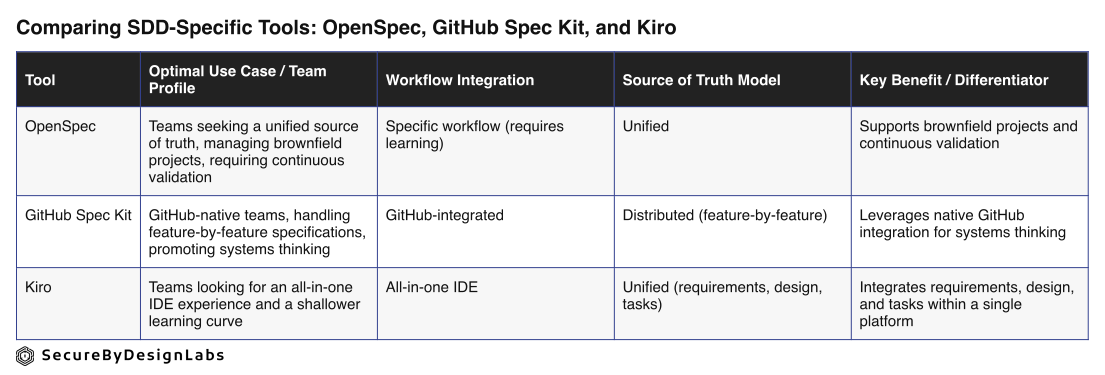
Tools like GitHub Spec Kit, Kiro, and OpenSpec represent diverse approaches to SDD, differing in workflow integration, source of truth model, and suitability for team size.
- OpenSpec: This tool is optimal for teams seeking a unified source of truth, managing brownfield projects (existing systems), and requiring continuous validation. Keep in mind it does necessitate learning its specific workflow.
- GitHub Spec Kit: Best suited for GitHub-native teams, handling feature-by-feature specifications, and promoting systems thinking. GitHub Spec Kit leverages native GitHub integration. Tools like Spec Kit function as extensible and intent-driven harnesses that guide coding agents throughout the Software Development Life Cycle (SDLC) or any business process.
- Kiro: Kiro offers an all-in-one IDE experience with a shallower learning curve, integrating requirements, design, and tasks within a single platform.
Next Steps
Begin by defining your AI agent’s core purpose and desired behavior as a structured, version-controlled specification, outlining clear goals, requirements, constraints, and acceptance criteria before writing any code. Consider implementing an example spec structure, such as one with sections for Goal, Requirements, Constraints, and Acceptance Criteria, detailing expected responses and validation rules.



Responses