
What is an AI Engineer? Roles, Responsibilities, and Day-to-Day

The rapid evolution of artificial intelligence often leaves engineers like you wondering where you fit in. New, highly specialized roles are emerging, and it’s easy to get them confused.
Understanding the clear distinctions between an AI Engineer, MLOps Engineer, and ML Platform Engineer is essential for building your career and for hiring managers looking to build effective teams.
This guide will cut through that confusion, clarifying each role, their workflows, and the skills you’ll need to navigate the AI development lifecycle effectively. By the time you’re done reading, you’ll have a solid grasp of what each role focuses on and how they contribute to delivering real business value through AI systems.
What Exactly Does an AI Engineer Do?
An AI Engineer is a software engineer responsible for designing, developing, implementing, and maintaining artificial intelligence systems and applications. This role involves end-to-end development and deployment of machine learning models, translating complex data into autonomous, real-time AI-driven solutions.
Here’s what an AI Engineer’s day-to-day work often involves:
- Fine-tuning and adapting AI models: This typically means adapting and fine-tuning existing (often pre-trained or foundation) models for a specific task — designing new model architectures from scratch is more commonly a Data Scientist or ML Researcher focus.
- Implementing AI solutions: You’re integrating these AI systems with your company’s existing business infrastructure.
- Managing data flow and infrastructure: Ensuring your AI systems are deployed and operating effectively requires careful data management.
- MLOps and AI lifecycle management: A key aspect of the role is MLOps and AI lifecycle management, which includes ensuring models are secure, fair, and explainable.
- Automating AI infrastructures: You’ll automate AI infrastructures to support data science teams with scalable solutions.
- Transforming ML models into APIs: This makes it easier for applications to integrate with your machine learning models.
- Integrating pre-trained models: AI engineers integrate pre-trained models, such as GPT or Claude, using APIs and ensure the reliability of these systems for users.
AI engineers are also increasingly responsible for responsible AI and compliance, including transparency obligations as mandated by regulations like the EU AI Act.
Understanding the AI Development Lifecycle
The AI development lifecycle is a roadmap that guides AI engineers from initial concept all the way through deployment and ongoing maintenance. It’s what ensures AI systems aren’t just cool ideas, but robust, reliable tools in production.
This lifecycle typically covers several key stages:
- Problem Definition & Data Collection: You start by clearly defining the problem you’re trying to solve and gathering all the necessary data.
- Data Preparation & Feature Engineering: This stage involves a lot of work to clean and prepare your data, making it suitable for model training.
- Model Selection, Design & Training: Here, you choose the right model, design its architecture, and train it. If you’re working with deep learning, your GPU infrastructure decisions will significantly impact both performance and cost.
- Validation, Testing & Iterative Refinement: You’ll thoroughly validate and test the model, then refine it iteratively to make sure it meets all performance and accuracy requirements.
- Deployment & Monitoring AI System: The final stage is getting the AI system out into the real world, setting up monitoring, and continuous maintenance. Many organizations make the mistake of thinking “model ready” means “system ready to deploy.” In reality, getting a system ready for deployment needs infrastructure, APIs, logging, monitoring, and solid rollback procedures.

AI Development Lifecycle Stages: A Reference for Engineers
Navigating the MLOps Lifecycle for AI Engineers
MLOps, or Machine Learning Operations, is critical for getting ML models into production and keeping them running smoothly at scale. For an AI Engineer, understanding and participating in the MLOps lifecycle is a core responsibility that connects your development work with the realities of production.
The MLOps lifecycle generally includes three main phases:
- Experimental Phase: This is where you develop, train, and evaluate models in a controlled environment.
- Production Phase: Here, you’re focused on operationalizing ML models at scale. This includes managing model deployment (think production-grade infrastructure, packaging, and containerization), building and maintaining CI/CD pipelines for ML, and managing data and feature stores.
- Monitoring Phase: This phase is all about ensuring your models continue to perform well and stay healthy over time. It covers monitoring model performance (health checks, logging, and detecting drift), automating retraining and lifecycle management, making sure systems are secure and compliant, and optimizing infrastructure and costs.
AI-Accelerated Engineering: A New Workflow
AI-accelerated engineering workflows are fundamentally changing how we deliver software by bringing AI agents into the process, which drastically reduces cycle time. The real benefit here isn’t just AI writing code faster than humans; it’s about cutting out frustrating wait states and low-judgment tasks. In these workflows, you, the human engineer, still own the critical decisions: specification, review, and approval. AI agents, on the other hand, handle the implementation, test scaffolding, and documentation.
First Line Software outlines a typical AI-accelerated engineering workflow, which involves five stages:
- Ticket Refinement & Specification: AI drafts acceptance criteria and edge cases from your tickets. Your job is to refine and approve them.
- AI Implementation: Once specs are approved, AI generates the implementation. You then review the AI-generated code for logic, architecture, and potential risks. Automated implementation can even use Test-Driven Development (TDD), where the agent writes a failing test first, then the code to pass it, which makes misleading tests harder to produce.
- AI Test Generation: AI scaffolds the tests, and you validate the coverage and add any domain-specific cases, taking ultimate responsibility for QA.
- Human Review & Static Analysis: AI runs static analysis and formats pull requests. You, as the human engineer, conduct the code review, check compliance gates, and debug any issues in the AI-generated code.
- Approve & Merge: Finally, you approve and merge the pull requests, ensuring product quality through rigorous testing.
To keep these workflows effective, a common practice is to manage coding tasks within a ‘smart zone.’ This means limiting context growth, resetting sessions predictably, and letting isolated subagents handle expensive exploration. Before implementation, a “Grill Me” session – or a similar human-in-the-loop interview – can help resolve any product ambiguity, with the agreed-upon destination summarized in a Product Requirements Document (PRD). You can also organize your work execution as dependency-aware vertical slices to get integrated feedback early and allow for safe parallel work.
The Distinct Roles: AI Engineer vs. MLOps vs. ML Platform Engineer
The terms AI Engineer, MLOps Engineer, and ML Platform Engineer often get used interchangeably, but for your career growth and for building effective teams, it’s crucial to see them as distinct roles with unique focuses and responsibilities within the AI ecosystem.
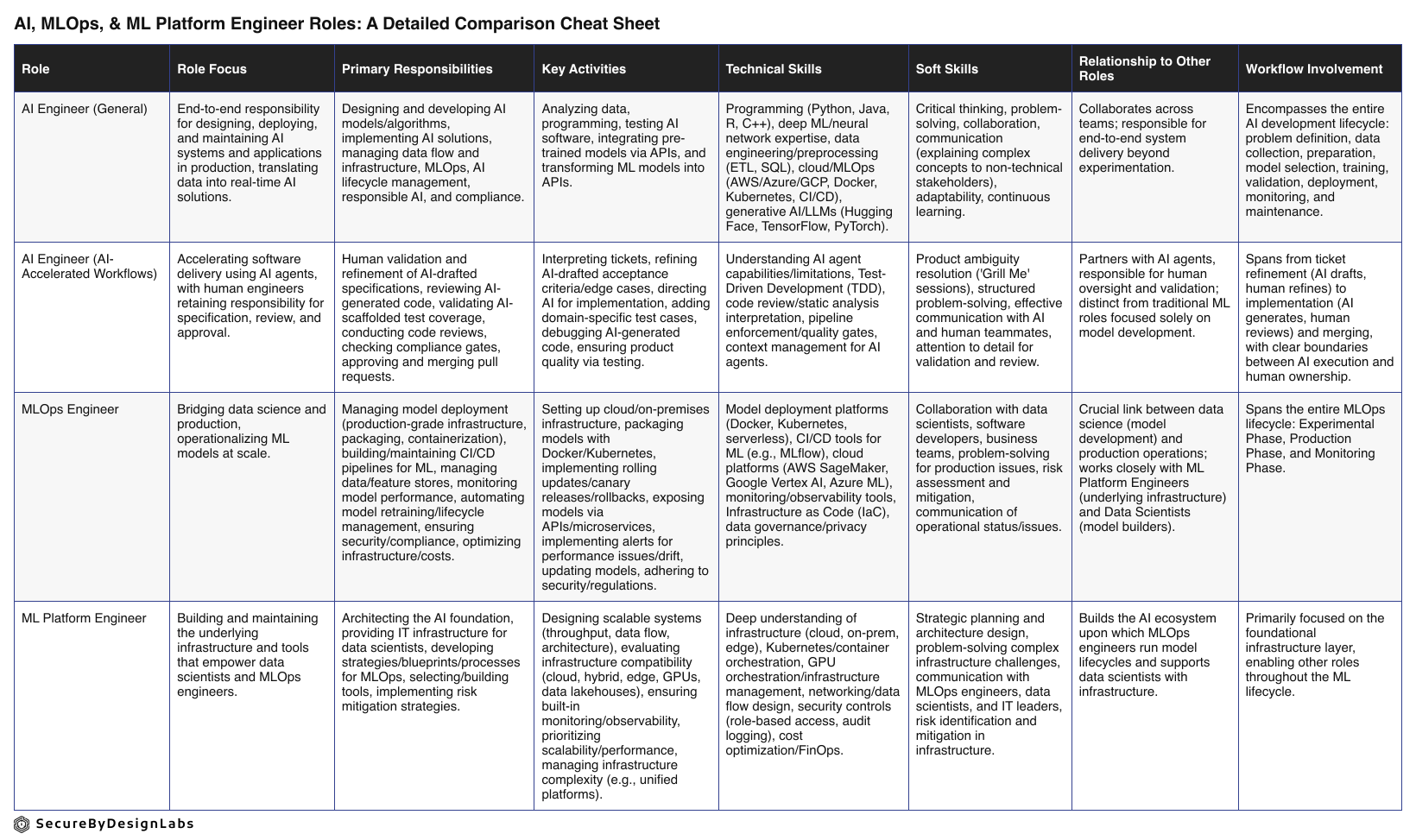
An AI Engineer (General) is responsible end-to-end for designing, deploying, and maintaining AI systems, translating data into real-time AI solutions. Their technical skills typically include strong programming knowledge (Python, Java, R, C++), deep machine learning and neural network expertise, data engineering and preprocessing (ETL, SQL), cloud and MLOps experience (AWS/Azure/GCP, Docker, Kubernetes, CI/CD), and familiarity with generative AI and LLMs (Hugging Face, TensorFlow, PyTorch). They are involved throughout the entire AI development lifecycle.
An AI Engineer (AI-Accelerated Workflows) focuses specifically on accelerating software delivery using AI agents. Their main responsibilities include human validation and refinement of AI-drafted specifications, reviewing AI-generated code for logic, architecture, and risk, validating AI-scaffolded test coverage, conducting code reviews and checking compliance gates, and approving and merging pull requests. Key technical skills for this role involve understanding AI agent capabilities and limitations, Test-Driven Development (TDD), code review and static analysis interpretation, pipeline enforcement and quality gates, and context management for AI agents (focused handovers). This role partners with AI agents, taking responsibility for human oversight and validation, and is distinct from traditional ML roles focused purely on model development. Their workflow involvement spans from ticket refinement to merging, with clear boundaries between AI execution and human ownership.
An *MLOps Engineer* bridges data science and production, operationalizing ML models at scale. Their responsibilities include managing model deployment (production-grade infrastructure, packaging, containerization), building and maintaining CI/CD pipelines for ML, managing data and feature stores, monitoring model performance (health checks, logging, drift detection), automating model retraining and lifecycle management, ensuring security and compliance of ML systems, and optimizing infrastructure and costs for ML workloads. They rely on technical skills like model deployment platforms (Docker, Kubernetes, serverless), CI/CD tools for ML (e.g., MLflow), cloud platforms (AWS SageMaker, Google Vertex AI, Azure ML), monitoring and observability tools, Infrastructure as Code (IaC), and data governance and privacy principles. This role is a crucial link between data science and production operations, working closely with ML Platform Engineers (who build underlying infrastructure) and Data Scientists (who build models), and their workflow involvement spans the entire MLOps lifecycle: experimental phase, production phase, and monitoring phase.
An *ML Platform Engineer* focuses on building and maintaining the underlying infrastructure and tools that empower data scientists and MLOps engineers. Their primary responsibilities include architecting the AI foundation, providing IT infrastructure for data scientists, developing strategies, blueprints, and processes for MLOps, and selecting and building necessary tools and implementing risk mitigation strategies. Key activities for them include designing scalable systems (throughput, data flow, architecture), evaluating infrastructure compatibility (cloud, hybrid, edge, GPUs, data lakehouses), ensuring built-in monitoring and observability, prioritizing scalability and performance (autoscaling, resource use), and managing infrastructure complexity for AI workloads (e.g., unified platforms). Technical skills needed are a deep understanding of infrastructure (cloud, on-prem, edge), Kubernetes and container orchestration, GPU orchestration and infrastructure management, networking and data flow design, security controls (role-based access, audit logging), and cost optimization and FinOps. This role builds the AI ecosystem upon which MLOps engineers run model lifecycles and supports data scientists with infrastructure, with their workflow primarily focused on the foundational infrastructure layer, enabling other roles throughout the ML lifecycle.
Below is a detailed comparison illustrating the distinguishing responsibilities, skills, and focus areas for each role:
AI, MLOps, & ML Platform Engineer Roles: A Detailed Comparison Cheat Sheet
Security Considerations in AI Engineering 
Security is a huge concern across the entire AI development and deployment lifecycle. AI engineers, MLOps engineers, and ML Platform engineers all have critical parts to play in making sure AI systems are sound, private, and compliant.
AI engineers are often involved in designing AI systems with fairness, privacy, and security built-in, and they act as stewards of responsible AI deployment, a point Splunk emphasizes. This means you’ll need to understand privacy, bias, and the risks associated with AI, as Digital Waffle points out. Regulations like the EU AI Act, which takes effect in stages starting August 2024, set specific transparency obligations for AI systems. AI engineers need to factor these into their designs and deployments.
Key security responsibilities often include:
- Data Governance and Privacy: You’ll ensure data is ready, high-quality, sufficient, accessible, governed properly, and private in all AI deployment strategies.
- System Compatibility and Scalability: You’ll tackle challenges like making sure systems are compatible and scalable without sacrificing security.
- Ethical Considerations: You’ll actively manage bias, accountability, and transparency in AI systems.
- Regulatory Compliance: You’ll need to adhere to evolving regulations that set specific security and transparency requirements for AI.
- Security Controls: For ML Platform Engineers, this includes managing security controls such as role-based access and audit logging.
- Risk Assessment and Mitigation: MLOps engineers will assess and mitigate risks in production environments, while ML Platform Engineers identify and mitigate risks in infrastructure.
Principal Engineer Lens: Strategic Impact and Oversight
For you, as a Principal Engineer, understanding the nuances of AI engineering roles means looking beyond the daily tasks. It’s about strategically architecting the AI foundation, planning for the long term, spotting risks, and optimizing your infrastructure and costs. This senior perspective highlights the essential human oversight and validation needed, especially in AI-accelerated workflows, to ensure AI agents are integrated responsibly and effectively.
Principal Engineers typically focus on:
- Architecting AI Foundations: ML Platform Engineers design scalable systems, focusing on throughput, data flow, and overall architecture, which provides the foundational infrastructure to empower data scientists and MLOps engineers.
- Strategic Planning for MLOps: You’ll be developing strategies, blueprints, and processes for MLOps to ensure long-term efficiency and scalability.
- Infrastructure Complexity Management: For AI workloads, this means ensuring built-in monitoring and observability, and prioritizing scalability and performance through tools like autoscaling and careful resource use.
- Risk Identification and Mitigation: You’re implementing comprehensive risk mitigation strategies at both the platform and operational levels, including robust security controls.
- Cost Optimization and FinOps: This involves actively managing the operational costs tied to data storage, compute for model training and inference, and ongoing monitoring.
- Human Oversight in AI Workflows: Even as AI agents speed up implementation and test scaffolding, human engineers, especially at your level, retain responsibility for crucial judgments. This includes specification, reviewing logic, and giving final approval to guarantee product quality and ethical alignment.
Common Mistakes to Avoid in AI Engineering
Navigating the complex world of AI engineering comes with its share of tricky spots. Recognizing and sidestepping common mistakes can significantly improve your project outcomes and boost your career path.
- Developing misaligned skills: You might focus on skills that don’t quite match real-world responsibilities, which can make it tough to land those ideal roles.
- Unclear role definitions: When organizations don’t clearly define roles, it can lead to hiring the wrong people and inefficient project execution.
- *Underestimating deployment*: Many organizations underestimate the deployment phase, thinking “model is ready” means “system is ready to deploy.” But getting to production needs infrastructure, APIs, logging, monitoring, and solid rollback procedures, as helium42.com points out.
- Neglecting ethical considerations: It’s a mistake to overlook important ethical considerations like bias, accountability, and transparency in your AI system designs.
- Losing context in AI chats: Long AI chats can lead to context growth, making it harder to keep coding tasks within a ‘smart zone’ and resulting in code that’s almost, but not quite, right. This shows why structured AI-accelerated workflows are so important.
- Failing to balance priorities: It’s easy to focus too much on technical precision and lose sight of user-friendliness, scalability, integration, and stakeholder concerns like ROI and timelines.
Next Steps
Ready to dive deeper and apply these insights to your own career or team? Explore our comprehensive guides and decision frameworks at SecureByDesignLabs.com to help you make smarter engineering decisions and accelerate your path to becoming an expert in AI-driven development. Join our newsletter to get weekly production-focused insights delivered directly to your inbox.



Responses